
Wooden Sleeper Fastening System-Dog Spike Fastening Combined Fastening Hook Headed Spike Fastening System
- Category: Track accessories
- Application:Wooden sleeper
- Rail type: <60kg/m
- Speed:<80km/h
- Standard: TB/T1345-79
Wooden Sleeper Fastening System Dog Spike Fastening Combined Fastening Hook Headed Spike Fastening System
1. Brief introduction:
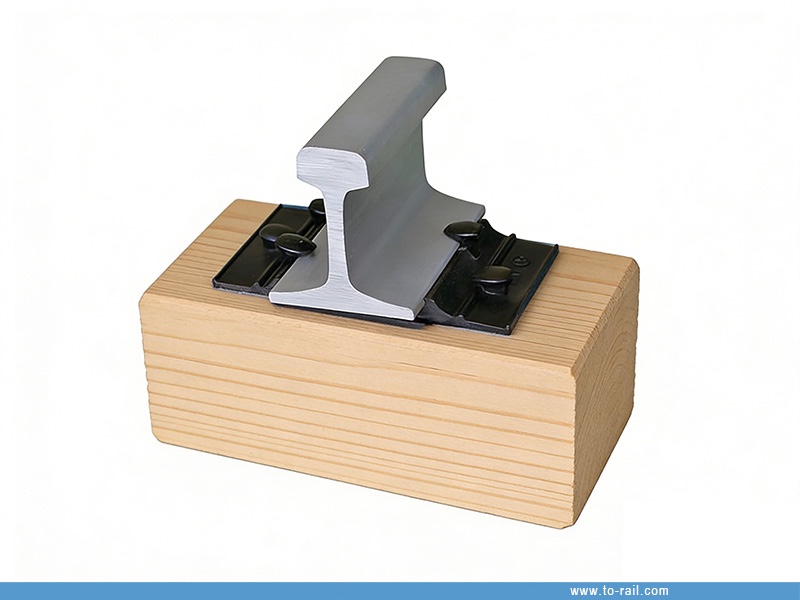
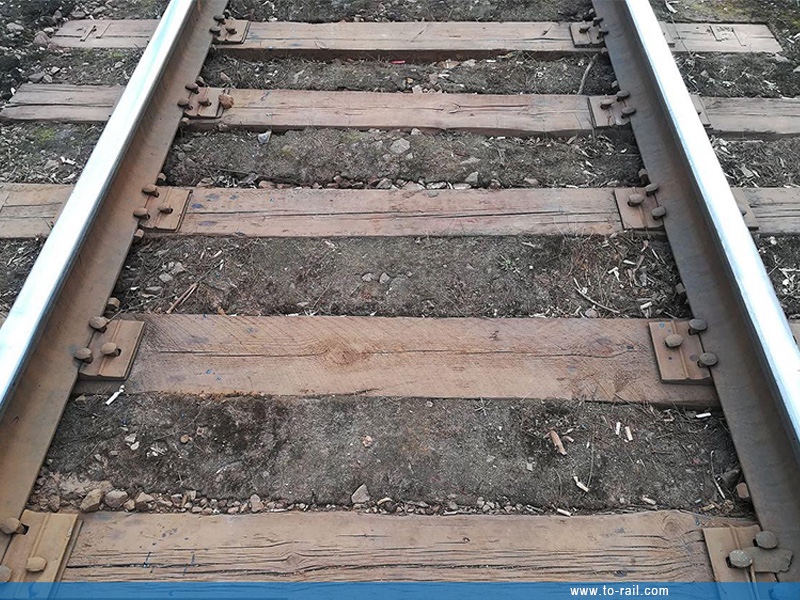
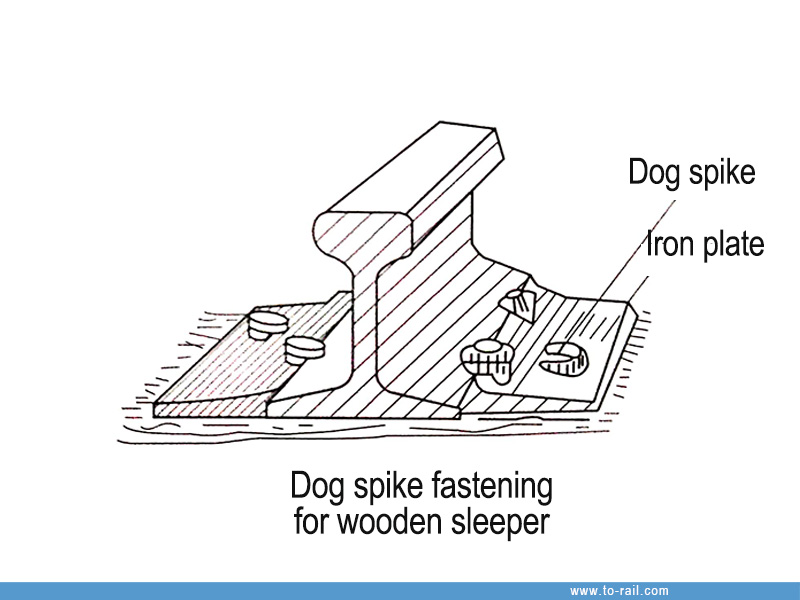
The dog spike fastener system is a traditional railway fastener type used to connect steel rails and wooden sleepers. It is mainly composed of two core components: hook-headed spikes and iron base plates, featuring a simple structure and low cost.
Its working principle is as follows: the hook-headed spikes are vertically driven into the wooden sleepers, and their hook-shaped lower parts—designed to match the rail base profile—firmly clamp the steel rails, thus restricting the rails’ longitudinal and lateral displacement as well as overturning. The iron base plates are placed between the steel rails and wooden sleepers to distribute train loads and prevent local stress concentration on the wooden sleepers.
This system enables convenient installation without complex tools. However, it has drawbacks in anchoring reliability and durability. Under long-term cyclic loading, issues such as spike loosening, pulling-out, and spike hole wear are prone to occur. Therefore, auxiliary devices including anti-creepers and gauge rods must be installed alongside. It is primarily suitable for low-speed, low-traffic scenarios such as branch lines of conventional railways, industrial sidings, and temporary tracks.
2. Main technical parameters:
|
Applicable sleeper |
Wooden sleeper |
|
Rail type |
<60kg/m |
|
Speed |
<80km/h |
|
Component |
Dog spike: carbon steel
Iron plate: QT450-10 |
|
Standard |
TB/T1345-79 |
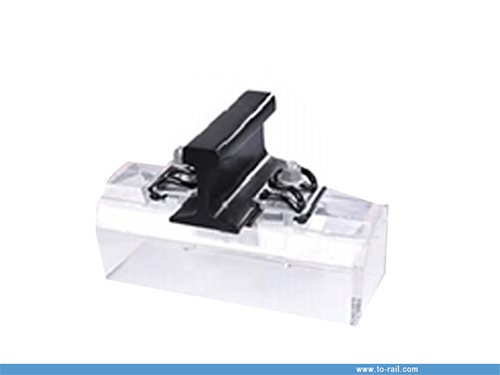
3. Structure Diagram:
INQUIRY
CATEGORIES
CONTACT US
Name: Ms. Zhang
Mobile:+86-13222235952
Whatsapp:+86-13222235952
Email:sales@to-rail.com
Add:Room B1701, Building 4, Dongfang Xintiandi, Yangshe Town, Zhangjiagang, Suzhou City, Jiangsu Province, China