
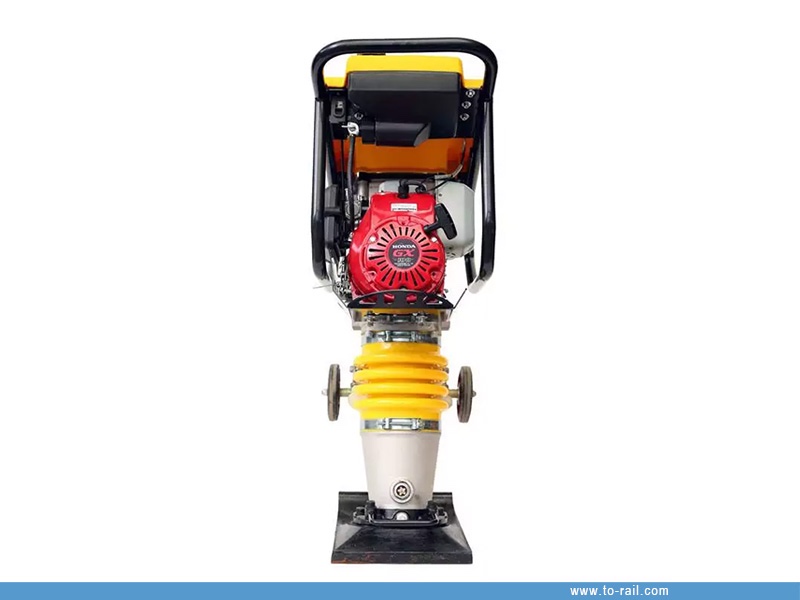
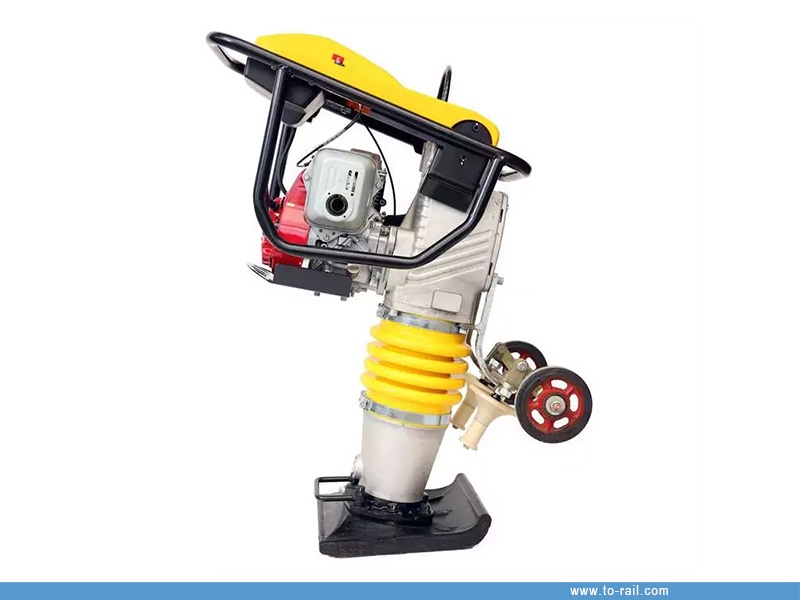
ZH-25 Gasoline Ballast Compactor - Professional Railway Maintenance Machinery
- Category: Track Maintenance Equipment
- Model: ZH-25
- Fuel Tank Capacity: 2.2 L
- Fuel Consumption: Approx. 1.3-1.5 L/h
- Engine Power: 2.2 kW, 4000 r/min
ZH-25 Gasoline Ballast Compactor - Professional Railway Maintenance Machinery
1. Brief introduction
ZH-25 Gasoline Ballast Compactor is a new-type track maintenance equipment designed for high-efficiency and high-quality ballast compaction work. It is most effective when operated in a group of three units, widely applicable to concrete sleeper tracks and turnouts. The gasoline-powered machine can perform tamping and compacting operations between sleepers and on ballast slopes, effectively improving the density and stability of the ballast bed, ensuring the safety and smoothness of railway operation. With reliable performance, easy operation and energy-saving features, it is an ideal choice for railway maintenance projects worldwide.
2. Technical Parameters
|
Item |
Specification |
|
Short Name |
Ballast Compactor |
|
Model |
ZH-25 |
|
Fuel Tank Capacity |
2.2 L |
|
Fuel Consumption |
Approx. 1.3-1.5 L/h |
|
Engine Model |
Honda GX100, Four-stroke |
|
Engine Power |
2.2 kW, 4000 r/min |
|
Impact Frequency |
600 times/min |
|
Jumping Height |
65 mm |
|
Operation Efficiency |
10 sections/min |
|
Travel Speed on Track |
17 m/min |
|
Compacting Speed on Track |
240 sleepers/group/hour |
|
Weight |
78 kg |
|
Overall Dimensions |
1000×770×380 mm |
3. Working Principle
The reduction device and connecting rod convert the circular motion of the engine into vertical impact motion of the compacting system. The connecting rod connected to the crank gear of the reducer drives the spring impact system to move up and down. The spring impact system consists of a spring and a piston installed between two spring seats. The piston is connected to the compaction plate and driven by the connecting rod linked to the crank gear. Plastic bushings on both sides of the piston prevent the spring from disengaging from the bottom. The piston and spring base are installed inside a spring guide cylinder, sliding up and down along the cylinder to achieve efficient ballast compaction.
4. Lubricant & Fuel Requirements
• Gasoline Engine: Only unleaded pure gasoline (Grade No.92) shall be used.• Lubricant for Impact System: No.40 mechanical oil.
5. Operation Instructions
|
Operation Stage |
Specific Steps |
|
Pre-operation Preparation |
1. Check whether connections such as the spark plug are loose. |
|
2. Check if the cooling air passage is blocked to avoid overheating during operation. |
|
|
3. Check the air filter for dirt. A dirty filter will seriously reduce intake quality, cause unstable engine operation and increase fuel consumption. |
|
|
4. Ensure the spark plug gap is maintained at approximately 0.6–0.7 mm. |
|
|
5. Pull the starter lightly 2–3 times to check normal engine operation. |
|
|
Engine Start & Operation |
1. Close the carburetor choke when the engine is cold. |
|
2. Open the throttle to 1/4~1/2 of full speed position. |
|
|
3. Pull the starter rope gently to start the engine. |
|
|
4. Open the carburetor choke after the engine runs stably. |
|
|
Shutdown Procedure |
1. Close the throttle to stop the engine. |
|
2. Lift the ballast compactor off the track and place it outside the safe construction clearance. The machine must be placed upright; tilting or laying down is strictly prohibited. |
6. Product Advantages
- Group Operation: 3 units work together for better compaction effect and higher efficiency.
- Wide Application: Suitable for concrete sleeper tracks and turnouts, applicable to both sleeper gaps and ballast slopes.
- Reliable Performance: Equipped with Honda GX100 four-stroke engine, stable and durable, low fuel consumption.
- Easy Operation: Simple operation steps, convenient pre-operation inspection and daily maintenance.
- High Quality: Effectively improves ballast bed density and stability, ensuring railway operation safety.
INQUIRY
CATEGORIES
CONTACT US
Name: Ms. Zhang
Mobile:+86-13222235952
Whatsapp:+86-13222235952
Email:sales@to-rail.com
Add:Room B1701, Building 4, Dongfang Xintiandi, Yangshe Town, Zhangjiagang, Suzhou City, Jiangsu Province, China